How Much Does a Trip to Korea Cost? (2026 Budget Guide)
⚡ Quick answer
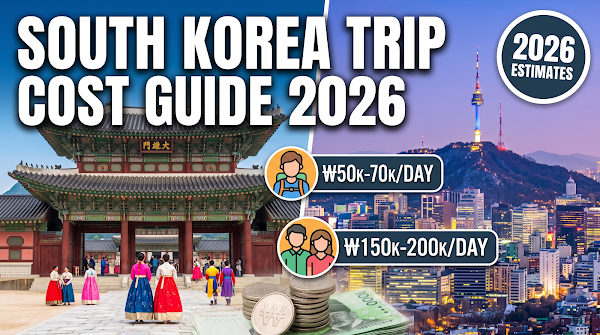
- Daily budget (per person, excluding flights): budget travelers spend around ₩50,000–70,000 ($37–52), mid-range ₩150,000–200,000 ($110–147), and luxury ₩350,000+ ($260+) a day.
- The sweet spot for most visitors is mid-range — private hotel room, restaurant meals, a KTX trip, some shopping.
- Flights are the biggest single cost. From the US, round-trip runs roughly $580–900; January–February are cheapest, summer and Chuseok/Lunar New Year the priciest.
- Korea is 15–25% cheaper than Japan for equivalent quality — food and transport especially.
- The best things are often free: palaces are a few dollars, temples and hiking are free, and world-class transit costs under $1.10 a ride.
- The real budget trap is shopping — K-beauty and fashion, not daily costs.
Korea surprises first-time visitors on price, and usually in the right direction. Travelers calibrated to European or Japanese costs assume that a country with this level of infrastructure, food, and rail must be expensive. It isn't. Korea sits in a productive middle ground: the free attractions are genuinely world-class, the local food is exceptional at modest prices, and the transport network — a premium experience anywhere else — is priced for everyday local use.
This guide breaks down exactly what a trip to Korea costs in 2026, category by category, with real prices — flights, accommodation, food, transport, attractions — plus daily budgets at three levels and full sample costs for a one-week trip. All figures are 2026 estimates at roughly ₩1,400 to $1; check a converter close to your trip, since rates move.
The Short Answer: Three Daily Budgets
Here is the realistic per-person daily spend in 2026, excluding international flights, which are covered separately below.
| Style | Per day | What it buys |
|---|---|---|
| Budget | ₩50,000–70,000 ($37–52) |
Hostel dorm, convenience-store and street food, subway everywhere, mostly free attractions |
| Mid-range | ₩150,000–200,000 ($110–147) |
Private hotel or guesthouse room, restaurant meals, Korean BBQ, paid attractions, occasional taxi |
| Luxury | ₩350,000+ ($260+) |
4–5 star hotel, fine dining and premium Hanwoo BBQ, private tours, taxis everywhere |
Most independent travelers land around ₩80,000–120,000 ($60–90) per day — a blend of a private room, a mix of restaurant and casual meals, transit, and a couple of paid experiences. That is the range to plan around if you are not sure which camp you fall into.
The one-line version: a comfortable week in Korea, flights aside, costs most people about ₩1,000,000–1,400,000 ($750–1,050) per person. You can do it well for half that, or spend three times more without trying hard.
Flights: Your Biggest Single Expense
For most visitors, the flight costs more than everything else on the trip combined, and it is also the cost you have the most control over through timing.
| From | Round-trip range (2026) | Notes |
|---|---|---|
| US West Coast | $580–800 | Nonstop from LA, SF, Seattle; budget carriers like Air Premia lowest |
| US East Coast | $700–1,000 | Often one stop; nonstops from NYC, DC, Chicago cost more |
| UK / Western Europe | £500–750 | Nonstops from London; one-stop via Gulf/Asian hubs cheaper |
| Southeast Asia | $200–450 | Short-haul budget carriers, frequent deals |
Three rules save real money here:
- Fly in the cheap months. January and February are consistently the lowest fares from the US — often 30–40% below peak — followed by September and November. Avoid late June through August and the Lunar New Year and Chuseok holiday weeks.
- Book a few weeks out. Booking at least two weeks ahead typically saves around 17% versus last-minute, and roughly 40 days out is a common sweet spot.
- Fly into Incheon (ICN). It is almost always the cheapest gateway, with the widest choice of carriers.
Accommodation: ₩20,000 to ₩800,000 a Night
Korea's lodging spans an enormous range, and the quality at every price point tends to beat the equivalent internationally. Where you land depends entirely on style.
| Type | Per night | Good to know |
|---|---|---|
| Jjimjilbang (sauna) | ₩15,000–20,000 | 24-hour bathhouse with sleeping areas — the ultra-budget wildcard, worth trying once regardless |
| Hostel dorm | ₩20,000–35,000 | Clean, well-located, often free breakfast and fast Wi-Fi |
| Guesthouse / goshiwon | ₩35,000–60,000 | Private room, sometimes tiny; great in Hongdae, Myeongdong, Insadong |
| 3-star hotel | ₩70,000–120,000 | The mid-range default; comfortable and central |
| 4–5 star hotel | ₩200,000–800,000 | International-standard luxury, often below Western prices for the tier |
Two money-savers worth knowing: book off-peak (January–February hotel rates run up to 40% below spring), and consider a jjimjilbang for a night or two — some travelers use them to skip a night's accommodation entirely while getting a genuine cultural experience.
Food: How to Eat Well on Any Budget
This is where Korea delivers the most value. You can eat extremely well for very little, and the gap between "cheap" and "great" is smaller than almost anywhere.
| Tier | Per meal | Examples |
|---|---|---|
| Street food | ₩1,000–5,000 | Tteokbokki ₩3,000–5,000, hotteok ₩1,500–2,500, fish cake skewer ₩1,000–2,000 |
| Convenience store | ₩3,000–6,000 | Triangle gimbap, instant ramen, canned coffee — a full breakfast under ₩5,000 |
| Casual restaurant | ₩8,000–12,000 | Gukbap, bibimbap, kalguksu, a market meal that leaves you stuffed |
| Korean BBQ | ₩15,000–40,000 | Per person; the experience every visitor should have once |
| Mid-range sit-down | ₩15,000–40,000 | Full-service restaurants, hanjeongsik set meals |
| Fine dining | ₩100,000+ | Tasting menus, premium Hanwoo beef |
Daily food spend works out to roughly ₩21,000 ($16) for a budget traveler living on convenience stores and gimbap, and about ₩52,000 ($39) for a mid-range day with restaurant meals and one Korean BBQ.
⚠ The hidden food cost is coffee. Korea's cafe scene is extraordinary and not cheap — specialty coffee runs ₩6,000–10,000 and a dessert another ₩7,000–14,000. If you cafe-hop daily it adds up fast. The budget fix: convenience-store coffee at ₩1,000–1,500 is genuinely decent.
Transport: The Category That Barely Costs Anything
Korea's public transport is one of the best systems in the world — fast, clean, English-signed — and priced for daily local use. It is the one category where budget and luxury travelers spend almost the same, because the subway has no first class.
Your first purchase should be a T-money card. Buy it at any convenience store for about ₩2,500 (the card itself) and load credit. It works on subways, buses, and many taxis across the entire country, and it saves ₩100 per trip versus single tickets, with free subway-to-bus transfers within 30 minutes.
| Mode | Cost |
|---|---|
| Subway (single ride, T-money) | ₩1,400 (+₩100 per extra 5km zone) |
| City bus | ₩1,400 |
| Taxi (base fare, Seoul) | ₩4,800, then ~₩1,000/km |
| Airport train (AREX all-stop, ICN→Seoul) | ~₩4,150 |
| KTX Seoul→Busan (reserved economy) | ~₩59,800 |
A full day of subway hopping rarely exceeds ₩5,000–7,000. The intercity KTX is the only transport line item that meaningfully affects your budget, and even that is cheaper than the Japanese equivalent.
Attractions and Experiences
Korea's headline sights are startlingly cheap, and many of the best are free. This is where the country quietly saves you money compared to Western city breaks.
- Palaces — Gyeongbokgung, Changdeokgung and the rest cost around ₩3,000. Wear hanbok and entry is free, and the last Wednesday of every month is free for everyone.
- Temples and hiking — almost always free, including Bukhansan National Park.
- DMZ tour — ₩55,000–85,000, guided and mandatory, the one big-ticket day.
- Observation decks (N Seoul Tower, BUSAN X the SKY) — roughly ₩20,000–30,000.
- Jjimjilbang — ₩10,000–15,000 for all-day access to baths and saunas.
- Norebang (karaoke) — ₩15,000–25,000 per person per hour, cheaper in a group.
- Theme parks (Everland, Lotte World) — ₩60,000–70,000, but book online for 30%+ off.
Budget roughly ₩12,000–25,000 a day for attractions on a mid-range trip, less if you lean on the free options.
The Costs People Forget
These are the line items that quietly inflate a Korea budget if you don't plan for them.
- SIM / eSIM / data — ₩15,000–30,000 for a tourist plan. Essential, and easy to forget.
- Shopping — the real budget trap. K-beauty and fashion are the categories that blow budgets, not daily costs. Set a shopping number in advance.
- Coffee and cafes — covered above, but worth repeating: ₩6,000–10,000 a cup adds up over a week.
- Travel insurance — not included in any daily figure here; budget separately.
- Airport transfers — cheap by train (₩4,150) but ₩60,000–90,000 by taxi late at night.
✅ Don't forget the tax refund — it's money back. Korea refunds most of its 10% VAT to tourists on purchases of ₩15,000+ per store. On serious shopping that is real money returned, so keep receipts and use the airport kiosks. And you never tip in Korea — it isn't expected and the price on the bill is final, so that is one Western cost you can delete entirely.
Sample Cost: One Week in Korea
Here is what seven days actually costs per person at each level, excluding international flights. These assume a Seoul-based trip with one KTX day trip.
| Category (7 days) | Budget | Mid-range | Luxury |
|---|---|---|---|
| Accommodation | ₩175,000 | ₩630,000 | ₩1,750,000 |
| Food | ₩150,000 | ₩350,000 | ₩700,000 |
| Transport (incl. 1 KTX) | ₩90,000 | ₩140,000 | ₩300,000 |
| Attractions | ₩80,000 | ₩150,000 | ₩400,000 |
| Data, extras | ₩35,000 | ₩60,000 | ₩150,000 |
| Total (excl. flights) | ~₩530,000 ($395) |
~₩1,330,000 ($990) |
~₩3,300,000 ($2,460) |
Add your flight on top — roughly $580–900 from the US — and a realistic all-in week runs about $1,000 budget, $1,600 mid-range, or $3,200+ luxury. Mid-range is where roughly 90% of visitors land, and it buys a genuinely comfortable trip.
How to Cut Your Korea Budget (Without Suffering)
The savings that actually move the needle, in rough order of impact:
- Fly in January or February. The single biggest lever — flights and hotels both drop 30–40%, and you skip the crowds. Trade-off is cold weather.
- Eat lunch, not dinner, at nicer places. Most restaurants offer lunch sets 30–40% cheaper than the same dinner menu.
- Use convenience stores strategically. A ₩3,500 GS25 breakfast versus ₩15,000 at a hotel, every morning for a week, is real money.
- Wear hanbok to a palace. Free entry, and a good photo — a rare case where the tourist thing is also the cheap thing.
- Lean on free attractions. Palaces, temples, hikes, markets, and neighborhoods are most of what makes Korea great, and they cost little or nothing.
- Book KTX and theme parks online in advance for the discounts.
Frequently Asked Questions
How much does a trip to Korea cost per day?
Excluding international flights, budget travelers spend around ₩50,000–70,000 ($37–52) per day, mid-range travelers ₩150,000–200,000 ($110–147), and luxury travelers ₩350,000 or more. Most independent visitors settle around ₩80,000–120,000 ($60–90) daily, covering a private room, a mix of restaurant and casual meals, transit, and a couple of paid experiences.
How much does a week in Korea cost?
For seven days excluding flights, expect roughly ₩530,000 ($395) at the budget level, ₩1,330,000 ($990) mid-range, and ₩3,300,000+ ($2,460) luxury per person. Adding a US round-trip flight of $580–900 brings the all-in total to about $1,000 budget, $1,600 mid-range, or $3,200+ luxury. Mid-range is where most visitors land.
Is Korea expensive to visit?
Less than most first-timers expect. Korea is consistently 15–25% cheaper than Japan for equivalent quality, especially food and transport, and its best attractions — palaces, temples, hiking, markets — are free or nearly free. World-class public transit costs under $1.10 a ride. The categories that get expensive are flights, cafe culture, and shopping, not the daily fundamentals.
When is the cheapest time to fly to Korea?
January and February are consistently the cheapest months for flights, often 30–40% below peak, followed by September and November. The most expensive periods are late June through August and the Lunar New Year and Chuseok holiday weeks. Booking a few weeks ahead and flying into Incheon rather than a regional airport also lowers the fare.
What is the biggest hidden cost of a Korea trip?
Shopping, by a wide margin — K-beauty and fashion are what actually blow travel budgets, not daily expenses. After that, Korea's excellent but pricey cafe scene (₩6,000–10,000 a coffee) adds up over a week, and a tourist SIM or eSIM (₩15,000–30,000) is easy to forget. Set a shopping budget in advance and use the tax refund to claw back 10% VAT on qualifying purchases.
Can I travel Korea on a tight budget?
Yes, though under $50 a day is tight for a full week. It means hostel dorms or jjimjilbangs, mostly convenience-store and street food, walking or limiting subway rides, and sticking to free attractions. It is very doable for a few days and manageable for longer with discipline. Around ₩70,000–90,000 ($50–66) a day is a more comfortable budget that still includes occasional restaurant meals and paid experiences.
Do I need to tip in Korea?
No. Tipping is not customary and is often refused at restaurants, bars, taxis, and hotels. The price on your bill is the final price, so you can remove tipping from your budget entirely — a genuine saving for travelers used to North American norms. The rare exception is international tour guides on multi-day or DMZ tours, where a tip is appreciated but optional.

Comments
Post a Comment