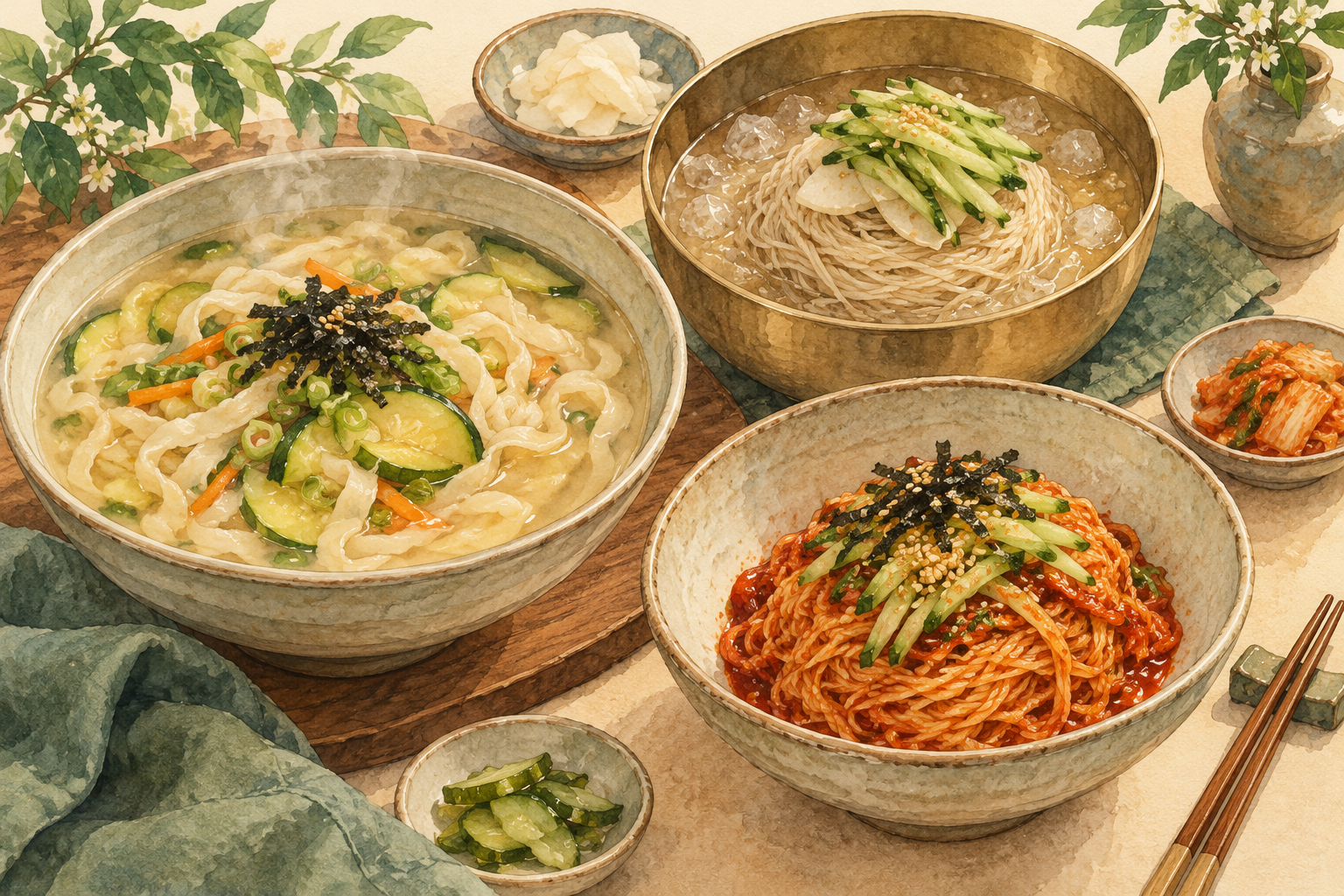
Choose Korean noodles by temperature, sauce and texture
In Korea, start with three questions: do you want hot soup or a cold dish, how much chili do you enjoy, and do you prefer thin noodles or a more substantial bite? These choices are more useful than guessing from your nationality or ordering whichever bowl appears most often in photos.
This guide compares four menu names using Korea Tourism Organization descriptions checked on 17 October 2026. The taste comparisons are editorial suggestions, not restaurant reviews or claims from personal tasting. For a broader meal choice, see our first-time Korean food guide.
Compare four noodle dishes before opening a menu
These four Korean noodle names give a starting point for choosing a bowl, while the restaurant must confirm the actual preparation.
| Menu name | Typical direction | Useful question |
|---|---|---|
| Janchi guksu · 잔치국수 | Hot noodle soup; a lighter broth-led option | What is the stock made from, and is seasoning separate? |
| Kalguksu · 칼국수 | Hot soup with knife-cut wheat noodles | Is this chicken, fish or shellfish broth? |
| Pyeongyang naengmyeon · 평양냉면 | Cold buckwheat noodles with a subtle broth | What is in the broth and noodle blend? |
| Bibim guksu · 비빔국수 | Noodles dressed with a sweet, spicy sauce | Can the sauce come separately? |
Choose one flavor direction first. If you want a familiar hot-soup format, start by asking about the two hot bowls. If chilled savory dishes appeal to you, consider the cold-broth option. If you enjoy chili-based dressings, ask about bibim guksu. These are preference matches, not promises that the dish will taste like something from home.
Janchi guksu: ask about stock and seasoning
KTO describes janchi guksu with a fish-and-kelp broth, scallions and egg garnish, with soy-based seasoning as an addition. A plain-looking bowl therefore should not be treated as a bowl of vegetables and water.
For a traveler who likes thin noodles and a broth-led meal, this is a useful menu name to recognize. Ask what seasoning is already in the bowl before adding anything from the table. If you want a less assertive flavor, requesting seasoning separately is clearer than simply asking for a “plain” dish.
Source: KTO's janchi guksu description, published 19 October 2023.
Kalguksu: choose the broth as carefully as the noodles
KTO describes kalguksu as knife-cut wheat noodles with broth variations including chicken, anchovies or clams. The word describes the noodle preparation rather than guaranteeing one stock or ingredient list.
If you enjoy wider noodles in hot soup, use kalguksu as your starting point and then read the full dish name. Ask whether the advertised portion is for one person or intended for sharing. If several people are ordering together, establish which bowls are individual before deciding how many to buy.
Source: KTO's kalguksu description, published 19 October 2023.
Pyeongyang naengmyeon: expect a deliberately cold bowl
KTO describes Pyeongyang naengmyeon as a chilled noodle dish with a subtle broth, and notes that buckwheat content affects the noodle texture. Cold serving temperature is part of the dish, not a sign that a hot meal has been left waiting.
If you are curious but usually prefer bold sauces, consider whether a restrained broth is what you want for this meal. Ask about any condiments before adding them, so you can adjust gradually. Do not assume that another naengmyeon dish on the same menu will have the same sauce, noodle blend or toppings.
Source: KTO's noodle overview, published 2 February 2024. Its restaurant prices and opening times are not reproduced here because they were not checked with the venues.
Bibim guksu: decide how much sauce you want
KTO describes bibim guksu with a sweet and spicy chili-based sauce and toppings such as egg and vegetables. Its description also notes variations, so a photo cannot establish your restaurant's exact version.
If you enjoy a dressed noodle dish, ask whether the sauce can be served on the side before ordering. A kitchen may use a prepared sauce that cannot be made non-spicy. If that is the case and chili is not what you want, choose another dish rather than expecting the same bowl without its main flavor.
Source: KTO's bibim guksu description, published 19 October 2023.
Use clear ordering questions in Korea
In a Korean noodle restaurant, ask about the feature that matters to you before confirming the order.
- “Is this served hot or cold?” — 따뜻한 음식인가요, 차가운 음식인가요?
- “Is it spicy?” — 매운가요?
- “Could you serve the sauce separately?” — 양념을 따로 주실 수 있나요?
- “What ingredients are used in the broth?” — 육수에 어떤 재료가 들어가나요?
- “Is this a portion for one person?” — 1인분인가요?
These phrases help start a conversation; they are not an allergy translation card or proof that a request can be accommodated. For seating, ordering and payment, use our solo restaurant guide.
Check dietary requirements separately from taste
For a meal in Korea, a dish name, clear broth or vegetable garnish does not establish allergy safety, vegan suitability or religious certification.
Ask the restaurant to check noodles, stock, sauce and toppings as well as shared preparation equipment. Do not infer that a buckwheat noodle is entirely buckwheat or free from another grain. If a restriction matters, get an ingredient and preparation answer for the actual dish, and verify any certification directly.
Use our restaurant allergy checklist or vegetarian and vegan ordering guide for a more detailed conversation. This is food-ordering information, not medical advice or a safety assessment of any restaurant.
Frequently asked questions about Korean noodles
For Korean noodle dishes, confirm the preparation at the restaurant rather than relying only on a translated menu name.
Which bowl should I consider if I dislike chili?
Ask about a broth-led janchi guksu or kalguksu and whether chili is already added. Neither name guarantees a non-spicy preparation.
Is cold naengmyeon a mistake?
No. A chilled bowl is the intended format described here. Confirm the menu item if you wanted a hot meal.
Are noodles with vegetables automatically vegetarian?
No. Ask about the stock, sauce, toppings and preparation; the visible vegetables do not answer those questions.
Can I ask for a fork or help with the menu?
Yes, you can ask. Availability and language support vary, so keep the Korean dish name available to show staff.
What this guide checked
On 17 October 2026, we checked the four linked KTO descriptions for dish identity, broad flavor, temperature and preparation. No restaurant menu, price, portion size, opening time, recipe, cross-contact control or religious certification was verified. This is a preference guide, not a restaurant ranking or a national-preference survey.