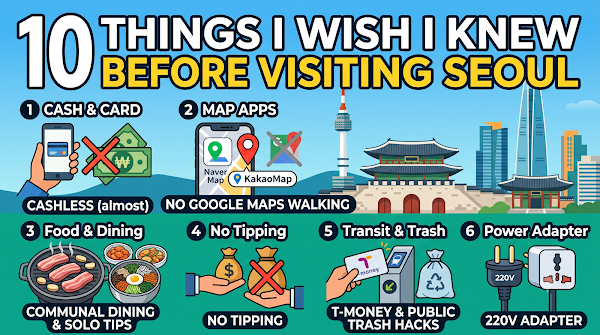
Quick answer: Bring a physical payment card and some won, prepare navigation and connectivity, and check your entry documents. Tap on and off with the same transit card and follow local signs.
Planning a trip to Seoul is exciting, but navigating a country with its own digital and cultural landscape can catch Western travelers off guard — from map apps that don't work to unwritten dining etiquette. To make your trip seamless, here are 10 things I wish I knew before visiting Seoul, with the practical hacks that actually matter on the ground.
1. Seoul Is Almost Cashless — but Carry Some Won
Card and contactless acceptance are different. Keep a physical card plus won for purchases and ordinary Tmoney top-ups. The new foreign-card machine option is for specified ticket products; see our Tmoney guide.
2. There Are Almost No Public Trash Cans
One of the first things you'll notice is how few public trash cans there are on the streets — a policy meant to cut down on illegal dumping.
The hack: Keep a small plastic bag in your daypack for trash. When you need to toss it, look inside subway stations, public restrooms, or the convenience store where you bought the item.
3. Tipping Is Not Expected (and Can Be Awkward)
If you're coming from the US, leave your tipping habits at home. In South Korea, tipping is simply not part of the culture. The price on the menu is exactly what you pay — tax and service are already included. Leave extra cash on the table and a server may well chase you down to return it.
4. Prepare Navigation Apps
Save your hotel’s Korean address and check a current route in Naver Map or KakaoMap. App coverage and features change, so avoid relying on an old blanket claim that another map app does not work.
For international-facing taxi booking, consider k.ride and review its current fare and payment options. See our app guide.
5. Korean Dining Is Communal (K-BBQ, Banchan & Solo Tips)
Korean food culture is deeply communal. Many traditional spots — especially Korean BBQ (K-BBQ) or bubbling stews like budae-jjigae — require a minimum order of two servings to start.
Solo travellers can look for individually portioned dishes. Ask about minimum orders, included side dishes and refill charges.
6. Free Wi-Fi Is Everywhere, but Get an eSIM Anyway
Seoul has some of the best public Wi-Fi in the world, in subways, cafes, and on the street. The catch: many public networks ask for a Korean phone number to authenticate.
The hack: Don't rely on public Wi-Fi alone. Buy a cheap data eSIM or rent pocket Wi-Fi at Incheon Airport so your navigation apps work in real time the moment you land.
7. Subway & Escalator Etiquette
Stand securely on escalators, hold the handrail and follow station safety signs. Keep conversations considerate and give priority seats to passengers who need them.
8. Pack a Plug Adapter (Korea Runs on 220V)
Korea uses 220V power with round two-pin plugs (Type C/F), the same as most of continental Europe.
The hack: Travelers from the US, UK, or Japan need a plug adapter. Most phone and laptop chargers handle 220V automatically, but double-check higher-wattage items like hair dryers and styling tools, which can burn out without a voltage converter.
9. Take Your Shoes Off Indoors
At traditional restaurants with floor seating, guesthouses, hanok stays, temple stays, and in Korean homes, you remove your shoes at the entrance.
The hack: Watch for a shoe rack or a raised step up from the floor — that's your cue to take them off. Wearing socks you don't mind showing saves a little awkwardness.
10. Convenience Stores Will Save You
Convenience stores can help with food, umbrellas and some transit services. Branch hours, facilities and ATM network support vary; check before relying on a late-night stop.
How to Prepare for Your Arrival
Before you step foot in the city, get your entry paperwork and transit plans sorted to skip long lines at the airport:
- Step 1 — Entry paperwork: Complete it online with our Korea K-ETA & e-Arrival Card Guide.
- Step 2 — Save on shopping: Learn how to claim money back with our Korea Tax Refund Guide.
- Step 3 — Get moving: Grab a transit card and read our T-money Card Guide to hit the ground running.
🗺️ Ready to explore? With the essentials sorted, map out your trip with our Ultimate 7-Day Seoul Itinerary.
Frequently Asked Questions
Do I need cash in Seoul, or is a card enough?
Bring an overseas-enabled physical card and some won. A particular terminal or kiosk may reject a foreign card; do not rely solely on phone contactless payment.
Do I tip in restaurants and taxis in Korea?
No. Tipping is not customary anywhere in Korea. The menu or meter price is the full price, with tax and service already included, so there's no need to add anything.
Which navigation app should I prepare?
Naver Map or KakaoMap are useful options for checking current routes. Save key addresses and compare the route shown with station and street signs.
What power adapter do I need for Korea?
Korea uses 220V with round two-pin plugs (Type C/F), like most of Europe. Bring an adapter if you're coming from the US, UK, or Japan, and check the voltage rating on high-wattage devices such as hair dryers.
Do I need to speak Korean to travel in Seoul?
No. Subway signs, station names, and many menus include English, younger locals often speak some English, and a translation app like Papago bridges the rest. You can navigate Seoul comfortably without Korean.
Plan the next step
Help in Korea: Emergency Numbers, Lost Items & Travel Support