Price note: Unless explicitly identified as an officially checked fare, amounts below are planning estimates retained from the archive. They are not live quotes. Confirm the final price for your date, branch and party size.
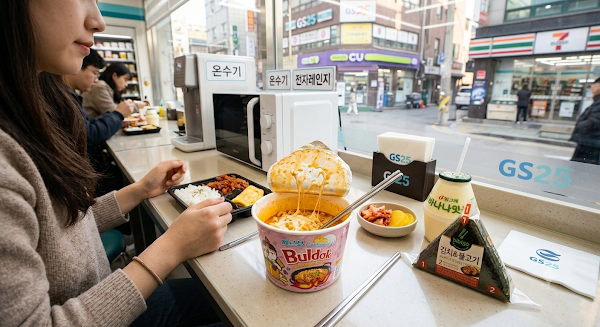
Korean convenience store food is a trip highlight in its own right, and this guide covers exactly what to buy, how to heat and eat it in-store, and the famous combos locals swear by. For a few thousand won, a CU or GS25 run delivers some of the best cheap eats in Seoul.
Quick summary
- The must-try items at Korean convenience stores, from cup ramyeon to banana milk.
- How to use the in-store hot water, microwave, ramyeon machine and seating.
- The most famous "combos" (kkul-jjogap) that go viral for a reason.
- Budget tip: a full convenience-store meal costs around ₩5,000–7,000.
The Big Three: CU, GS25 & 7-Eleven
Convenience stores are everywhere in Korea — often several on a single block. The three biggest chains are CU, GS25 and 7-Eleven, with Emart24 also common. Selection overlaps a lot, but each chain has its own exclusive snacks and private-label ranges, so it's worth peeking into different ones. Most are open 24 hours, accept cards and mobile pay, and stock hot food, drinks, household items and a surprising amount of ready-to-eat meals.
How to Use a Korean Convenience Store
The magic is that you can turn raw items into a hot meal right in the store. Most branches have a self-service counter with everything you need:
- Hot water dispenser for cup ramyeon and instant soups.
- Microwave to heat lunchboxes (dosirak), buns and rice bowls — peel back the film first.
- Ramyeon machine at many branches: place your bowl, press start, and it cooks fresh noodles for you.
- Seating — counters or tables (often by the window or outside) where you can eat on the spot.
Pay before opening or preparing food unless staff specifically direct otherwise. Ask which microwave, hot-water and seating facilities this branch provides.
Best Korean Convenience Store Food to Try
Here are the essentials worth seeking out. Prices are illustrative planning estimates, not checked current menus.
Cup ramyeon: follow the exact package instructions for hot water, microwaving and preparation time. Product sizes, ingredients and prices vary.
Samgak gimbap (triangle kimbap) — a triangle of rice and filling wrapped in seaweed; follow the numbered tabs to open it without tearing the nori. About ₩1,200–1,800.
Dosirak (lunchbox) — a full microwaveable meal of rice, meat and side dishes; the cheapest hot meal in Korea. About ₩4,000–5,500.
Hotbar — a savory fish-sausage snack on a stick, ready to eat warm. About ₩1,500–2,000.
Sandwiches & toast — surprisingly good egg, ham and fruit-cream options for a quick breakfast. About ₩2,500–4,000.
Banana milk — Korea's iconic sweet banana-flavored milk in a chubby bottle; a must-try. About ₩1,500–2,000.
Mandu (dumplings) — frozen or chilled dumplings you microwave in minutes. About ₩3,000–4,500.
Hoppang — a fluffy steamed bun with sweet red bean or pizza filling, sold hot in winter. About ₩1,200–1,800.
Ice cream — Melona (melon bars) and World Cone are the crowd favorites year-round. About ₩1,000–2,500.
String cheese — not a snack on its own, but the secret weapon in Korea's most famous ramyeon combo (below). About ₩1,500–2,500.
Famous Convenience Store Combos
Half the fun is mixing items into the combos (kkul-jjogap, "honey combos") that Koreans love. These go viral for good reason:
| Combo | What to mix | Why it works | Approx. total (₩) |
|---|---|---|---|
| Buldak + cheese | Buldak cup ramyeon + string cheese | Melted cheese tames the fire and adds creaminess | 3,500–5,000 |
| Ramyeon + gimbap | Cup ramyeon + triangle gimbap | Dip the gimbap in the broth for a full meal | 2,500–4,000 |
| Dosirak + ramyeon | Lunchbox + small cup ramyeon | The classic hearty, cheap dinner | 5,500–7,500 |
| Banana milk + bread | Banana milk + any sweet bun | Simple, nostalgic Korean breakfast | 3,000–4,000 |
| Melona float | Melona bar + lemon soda | A DIY melon ice-cream float | 2,500–4,500 |
Convenience Store Tips for Travelers
A few tricks stretch your won further and make the experience smoother:
Look for 1+1 and 2+1 deals. Tagged items give you a free extra when you buy one or two — drinks, snacks and ramyeon rotate through these constantly.
Peel the film before microwaving. Lift the corner of a dosirak's plastic cover so steam can escape, then heat for the time printed on the label.
Late night is convenience-store prime time. When restaurants close, a 24-hour CU or GS25 is your reliable, cheap meal — and often has seating.
Final Bites: Your Convenience Store Run
Make your first stop count:
- First-timer must-try: a cup ramyeon cooked in-store plus a triangle gimbap.
- Go viral: try the Buldak-and-cheese combo at least once.
- Sweet finish: banana milk and a Melona bar.
- Budget win: a dosirak makes a complete hot dinner for around ₩5,000.
Round out your eating plan with our Korean Food Guide: 20 Must-Try Dishes and Korean Street Food Guide, and grab the tools you'll need in 5 Essential Apps for Korea.
Frequently Asked Questions
What should I buy at a Korean convenience store?
Cup ramyeon, triangle gimbap, a lunchbox and banana milk are common items to look for, but stock and prices differ by branch. Read the label for preparation and ingredients.
Can you eat inside Korean convenience stores?
Yes. Most branches have a self-service station with a microwave, hot water and a ramyeon machine, plus counter or table seating where you can eat your food on the spot — a normal and popular thing to do.
How do you cook cup ramyeon at a convenience store?
Open the lid to the fill line, add hot water from the dispenser, close it, and wait about 3 minutes. Many stores also have a ramyeon machine that cooks fresh noodles for you when you press start.
What is the most popular Korean convenience store combo?
The Buldak ramyeon with string cheese combo is the most famous, since the melted cheese balances the intense spice. Cup ramyeon dipped with a triangle gimbap is another beloved everyday combo.
Are Korean convenience stores open 24 hours?
Most are open 24 hours, seven days a week, which makes them a reliable late-night meal option after restaurants close. A few smaller or office-area branches keep shorter hours.
How much does a convenience store meal cost in Korea?
A satisfying meal runs about ₩5,000–7,000, such as a dosirak lunchbox with a drink, or cup ramyeon with a gimbap and banana milk. Watch for 1+1 and 2+1 deals to save even more.